


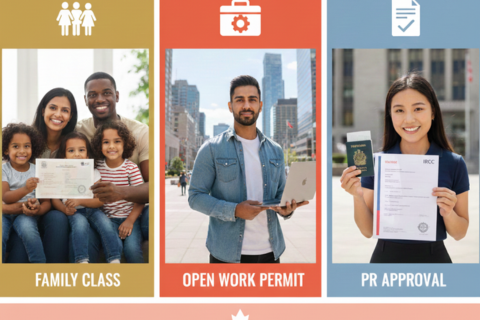
Sponsored spouses and common-law partners have a crucial opportunity to apply for an Open Work Permit (OWP) while their Permanent Residence (PR) application is in process. This option is available provided the applicant is currently residing in Canada with their sponsor and meets specific eligibility criteria.
The Power of the Open Work Permit
Securing an OWP for your sponsored partner is highly recommended, especially since the PR application processing can often take a year or longer. The OWP provides two immediate and significant benefits:
- Work Flexibility: The permit grants the holder the immediate legal right to work for any employer, in any location across Canada. The partner is not tied to a single employer, offering significant freedom in their job search (standard restrictions apply, such as those requiring specific medical exams).
- Continuous Legal Residency: It ensures the sponsored individual maintains extended legal temporary resident status, allowing them to stay legally and continuously with their sponsor in Canada while they await the final PR decision.
OWP Eligibility Across Sponsorship Classes
The Spousal OWP is available to applicants under both of the primary Canadian sponsorship classes:
- Inland Sponsorship: (Spouse or Common-Law Partner in Canada Class)
- Outland Sponsorship: (Family Class)
What This Guide Explains
This article provides essential clarity on navigating the sponsorship process by explaining:
- The key operational differences between Inland and Outland sponsorship.
- How the Spousal Open Work Permit (OWP) is integrated into each sponsorship option.
- How those applying via the Outland route can initially enter Canada on a visitor visa and subsequently change their status to a worker upon arrival.
Inland vs. Outland Spousal Sponsorship: A Comparison
Understanding the difference between the two primary Canadian sponsorship pathways is crucial for determining how the Open Work Permit (OWP) option fits into your application strategy.
| Feature | Inland Sponsorship (Spouse or Common-Law Partner in Canada Class) | Outland Sponsorship (Family Class) |
|---|---|---|
| Location of Applicant | Must be living with the sponsor in Canada. | Can be living outside Canada or in Canada without intending to stay for the full processing time. |
| Status Requirement | Must have valid temporary status (visitor, worker, student) or be covered by a specific public policy. | No specific status requirement for the sponsored person. |
| Expectation During Processing | Required to remain in Canada throughout the entire process. | Can travel in and out of Canada. |
| Right to Appeal Refusal | NO right of appeal to the Immigration Appeal Division (IAD). | Right to appeal a refusal to the IAD. |
| Note | Outland applications can also be submitted from within Canada. | The OWP is a key tool to bring outland applicants into Canada while processing continues. |
Who Qualifies for the Spousal Open Work Permit (OWP)?
The OWP allows your sponsored partner to work immediately while awaiting the final Permanent Residence (PR) decision. Immigration, Refugees and Citizenship Canada (IRCC) sets strict rules for eligibility:
The sponsored spouse or partner must meet the following conditions:
- Residence: They must be residing in Canada with the sponsor at the time of the OWP application.
- Genuine Relationship: They must be in a bona fide (genuine) relationship with the sponsor.
- PR Application Status: They must be included as the sponsored person in a PR application that has been deemed complete by IRCC.
- Acknowledgment of Receipt (AOR): They must have received the Acknowledgment of Receipt (AOR), confirming IRCC has started processing the complete PR application package.
- Temporary Status: They must hold valid temporary resident status in Canada (visitor record, work permit, study permit) or be authorized to stay under IRCC's public policy (even if out of status, they must have received "approval in principle").
When the OWP Policy Does Not Apply
Your spouse or partner cannot utilize this OWP policy if:
- Their PR application has been refused, withdrawn, or returned.
- They attempt to apply for the work permit at a port of entry (this OWP policy applies only to in-Canada applications).
Inland Sponsorship + Open Work Permit: The Process
If you apply under the Inland Sponsorship Class and your partner currently holds a valid temporary status in Canada, the OWP process is generally streamlined:
- Submit the PR Application: The sponsor must submit the full PR sponsorship application package (Inland Class) using the official IRCC online portal.
- Receive AOR: IRCC reviews the submission for completeness. Once accepted, they issue the AOR to the sponsor, confirming processing has officially begun.
- Apply for OWP: The sponsored spouse or partner then applies for the Spousal Open Work Permit online through their own separate IRCC secure account.
- Complete the Work Permit Form:
- They must identify the application as an "Open work permit."
- They must reference the special public policy for Inland Spousal/Common-Law Partner in Canada Class applicants in the job title and duties sections of the form.
- Upload Supporting Documents: Key documents required include:
- The AOR received from IRCC.
- Proof of their current valid temporary resident status in Canada.
- Proof of the genuine relationship (e.g., marriage certificate, common-law declaration, and supporting documentation).
During OWP Processing
- Maintain Status: The sponsored partner must actively maintain their legal temporary status in Canada until the OWP is issued.
- No Unauthorized Work: They are strictly prohibited from beginning new employment until the OWP is officially issued (unless they hold a pre-existing work permit and qualify for "maintained status").
Processing times for this OWP are variable; applicants should consult the IRCC online processing times tool for the most current estimate.
Outland Sponsorship + Open Work Permit: Entering Canada on a Visitor Visa
While Outland sponsorship applications are typically designed for applicants residing outside Canada, it is still possible for the sponsored partner to gain work rights inside the country. However, they must first enter Canada legally and meet the same in-Canada eligibility conditions as Inland applicants.
The key is leveraging the Open Work Permit (OWP) public policy after entering Canada as a temporary resident.
The Path for Outland Applicants
IRCC has established a clear sequence for Outland applicants to transition their status upon arrival:
- Submit PR Sponsorship and Receive AOR: The sponsor submits the PR application under the Family Class. The couple must then wait for IRCC to review the application and issue the Acknowledgment of Receipt (AOR), confirming the PR process is underway.
- Apply for a Visitor Visa: Once the AOR is secured, the spouse or partner (who is currently outside Canada) can apply for a Visitor Visa (Temporary Resident Visa - TRV) to travel to Canada.
- Expedited Processing: IRCC acknowledges that spouses and partners with an AOR may be eligible for faster processing of their Visitor Visa application, provided they meet all standard TRV requirements (e.g., ties to their home country, finances). Approval is not guaranteed.
- Enter Canada as a Visitor: Once the TRV is approved, the sponsored partner enters Canada as a temporary resident (visitor) and must begin living with the sponsor during the PR processing period.
- Apply for OWP from Within Canada: After arrival, the sponsored partner can apply for the OWP under the same public policy used by Inland applicants, provided they meet all conditions:
- They are physically in Canada and living with the sponsor.
- The relationship is genuine.
- They have an AOR confirming the PR sponsorship is in process.
- They hold valid temporary resident status (visitor, worker, student) or qualify under the special spousal public policy.
Note: From the point of the OWP application, the process (forms, secure account, and required wording in the application) becomes essentially the same as the process for Inland sponsorship applicants.
Processing Times for the Spousal Open Work Permit
The Spousal Open Work Permit (OWP) allows your partner to work while their Permanent Residence (PR) application is pending. Processing times are frequently updated by IRCC and can vary based on several factors.
Current Processing Averages
Based on recent official IRCC data for in-Canada work permit applications (the category the Spousal OWP falls under once the PR application is submitted), the typical wait time is often several months.
- In-Canada Applications: As of late 2025, work permit applications submitted from within Canada (including Spousal OWP) often take approximately 6 to 8 months (190–196 days) to process.
- Outland/Port of Entry (Limited): If an applicant is exempt from the Temporary Resident Visa (TRV) requirement and is applying at a Port of Entry (which is highly limited), the permit can be issued immediately.
Key Factors Affecting Processing Time
It is essential to understand that the time estimate starts the day IRCC receives a complete application and ends when a decision is made. Your specific timeline may be longer or shorter based on:
| Factor | Impact on Timeline |
|---|---|
| Application Completeness | Major Factor. Incomplete applications are returned and must be resubmitted, causing significant delays. |
| Biometrics | Delays in providing biometrics (fingerprints and photo) after receiving the request letter will halt processing. |
| Response Time | How quickly you respond to any requests from IRCC for additional documents or information. |
| Case Complexity | Issues like previous immigration history, complex background checks, or inadmissibility can extend the timeline. |
Where to Find the Most Current Time
Because processing times are frequently adjusted by IRCC based on application volume and operational capacity, applicants should always check the official IRCC processing times tool for the most accurate, up-to-date estimate specific to their application type and country of submission.