


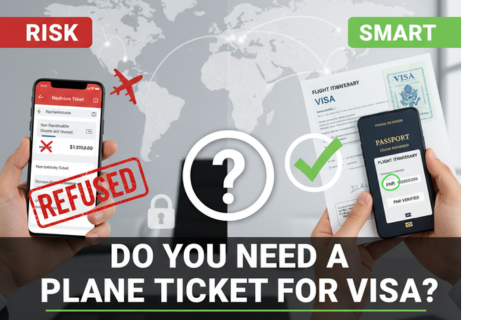
Flight Documentation for Your Visa: Is a Confirmed Ticket Necessary?
As you begin the visa application journey, the section regarding your travel itinerary often causes confusion. Do you actually need to purchase a flight ticket before the consulate reviews your paperwork?
This requirement is one of the most debated aspects of the process. Some applicants rush to book, creating a financial risk if the visa is denied or delayed. Others inquire about using a "flight itinerary" or a temporary reservation, but are unsure if these documents are legally acceptable or reliable. (For more clarity, we encourage you to review our dedicated travel FAQs and articles).
Whether you are a student planning your first international education trip, a family member applying to visit relatives, or a global traveler arranging your next destination, this decision is important. Your goal is to satisfy the consulate's travel proof requirements without financially committing to expensive flights before your visa is officially granted. Find out how our services can simplify your application process on our information page.
The Truth About Flight Bookings for Visa Applications
It is generally not necessary to purchase a full, non-refundable plane ticket when submitting your visa application.
The majority of embassies and consulates worldwide only require a verifiable flight reservation—sometimes referred to as a temporary booking or flight itinerary—to establish your genuine intent to travel and depart. This reservation should typically include a working Passenger Name Record (PNR) that can be validated, or at least a detailed itinerary showing proposed dates of entry and exit.
Key Takeaway: You should aim to provide documentation that proves your planned travel dates without the financial risk of buying a final ticket. Many reputable online services offer temporary, embassy-accepted flight reservations that comply with documentation standards for various visa types, including those for the Schengen Area, UK, US, and GCC nations.
Here is the revised Table of Contents, modified to eliminate specific, potentially proprietary phrasing and provide a fresh, universally applicable structure:
Your Visa Flight Proof: A Guide to Travel Documentation
- Ticket or Reservation? The Straightforward Answer
- Why Travel Proof is Mandatory (Understanding Consular Concerns)
- Defining Acceptable Documentation (Flight Itinerary vs. Confirmed Purchase)
- Understanding Temporary Flight Holds
- What a "Hold" Is (And What It Is Not)
- The Importance of the PNR (Passenger Name Record)
- The Best Methods for Securing a Valid Flight Itinerary
- Country-Specific Rules (Focusing on major destinations like the Schengen Area, USA, and UK)
- Managing Financial Risk and Timing (What Happens if the Visa is Refused?)
- Case Studies: Real-World Examples of Document Submission
- Preparing Your File for Review (Tips for Clean Submission)
- Evaluating Reservation Providers (Key Factors for Verifiable Service)
- Final Verdict: Documenting Your Flights for Visa Success
Your Visa Flight Proof: A Guide to Travel Documentation
This guide breaks down what embassies actually mean when they ask for a flight itinerary, when a fully paid ticket is really necessary, and how verifiable flight reservations (often facilitated by third-party services) fit in. By the end, you’ll know exactly how to handle this requirement without stress or unnecessary financial risk. We'll explore various scenarios, provide practical tips, and ensure you have all the information needed to make informed decisions for your visa journey.
1. Ticket or Reservation? The Straightforward Answer
When applying for a visa, the embassy or consulate almost universally requests proof of planned travel—specifically, an entry and exit itinerary. This is to confirm your intent to leave their territory.
The Key Distinction:
| Document Type | Also Known As | Requirement | Financial Risk |
|---|---|---|---|
| Flight Reservation | Flight Itinerary, Booking Hold, Dummy Ticket (colloquial) | Accepted by most embassies for the initial application. | Minimal/Low (Small fee for the hold/service) |
| Confirmed Purchase | Issued Ticket, Paid Ticket, E-Ticket | Required only in rare, specific circumstances (e.g., transit visas, or if explicitly requested in writing). | High (Loss of money if the visa is denied) |
The Consensus: Embassies strongly advise against purchasing non-refundable tickets until your visa is approved. A verifiable reservation provides the necessary details while mitigating your financial risk.
2. Why Travel Proof is Mandatory (Understanding Consular Concerns)
It's common to wonder why a visa officer needs your flight details. The documentation serves as a practical tool for compliance and risk assessment.
What Reviewers Need To Verify
- Duration Validation: Your flight dates must align with the short-stay or long-stay visa category you are applying for. The itinerary helps the officer grant a visa that covers your exact planned trip length.
- Consistency: The travel dates must match the dates provided on your travel insurance, hotel bookings (Proof of Accommodation), and invitation letters. Discrepancies are a major red flag.
- Proof of Onward Travel: This is the most crucial point. A round-trip or onward flight reservation demonstrates a concrete plan to depart the destination country, reducing the risk of you overstaying the visa.
Risk Signals They’re Screening Out
Consular officers are trained to identify intent to misuse a visa. A vague or one-way itinerary (for a tourist visa) suggests open-ended travel, which raises suspicion about the applicant’s intention to return home. A solid, round-trip itinerary is a powerful sign that your stay is temporary and well-organized.
3. Defining Acceptable Documentation (Itinerary vs. Confirmed Purchase)
What Counts As Acceptable Proof Of Flights
An acceptable flight document for a visa application must contain verifiable information:
- Full Name(s): Must match the name exactly as written in your passport.
- Itinerary Details: Full route, including all layovers, flight numbers, and airline name.
- Dates: Clear entry and exit dates that cover the entire duration of the trip.
- Booking Code: A verifiable reservation number, typically the PNR.
4. Understanding Temporary Flight Holds
Flight Reservations 101: What They Are (And Aren’t)
A flight reservation is a temporary booking created in the airline’s Global Distribution System (GDS). It is a genuine entry in the airline's system but is not yet ticketed (paid for in full).
- What it Is: A verifiable placeholder with a unique code.
- What it Isn't: A fully paid, issued ticket that guarantees you a seat on the plane without further action.
The Role of the PNR (Passenger Name Record)
The PNR is a unique, six-character alphanumeric code generated for every booking made in the GDS. Its role in your visa application is critical:
- Verification: A visa officer can use the PNR code and your last name on the airline’s "Manage Booking" tool (or a GDS website like CheckMyTrip) to verify that the itinerary is real and active.
- Authenticity: Documents with a valid PNR are considered authentic proof of travel planning, whereas a simple, non-verifiable screenshot could be rejected as fraudulent.
5. How To Get A Verifiable Flight Reservation The Right Way
Avoid creating non-verifiable (or "fake") documents. The proper ways to secure a trusted flight reservation include:
| Method | Cost/Risk | Validity Period | Pros & Cons |
|---|---|---|---|
| Travel Agency/Service Provider | Low Fee (typically $<\$30$) | 48 hours to 14 days (Provider-dependent) | Pros: Dedicated service, long holding time, tailored for visa submission. Cons: Requires a small fee. |
| Direct Airline Hold | Free or Small Fee | 24 to 72 hours | Pros: Direct from the airline. Cons: Very short hold time, often expires before the visa decision. |
| Fully Refundable Ticket | High Cost (Full ticket price) | Permanent | Pros: Zero risk of booking expiring, fulfills any request for a "paid" ticket. Cons: Very expensive upfront, long refund processing time if the visa is denied. |
Best Practice: Use a specialized travel service to get a reservation with a valid PNR that is guaranteed to be verifiable at the time of submission, saving you hundreds of dollars in upfront ticket costs.
6. Country & Visa-Type Nuances You Should Know
While the general rule (reservation over purchase) applies globally, some countries have unique emphasis:
- Schengen Area (Europe): Consulates explicitly advise against buying tickets. They require a Round Trip Reservation or Itinerary with flight numbers and dates. The reservation must cover your planned entry and exit from the entire Schengen zone.
- US and UK: These countries generally do not require a paid ticket for the visa application. For B-1/B-2 (US Tourist) visas, the focus is more on your ties to your home country. For UK Standard Visitor visas, an itinerary is sufficient. The key documentation is the intent to return.
- GCC Countries (e.g., UAE, Saudi Arabia): Proof of a return or onward ticket is often strictly enforced at immigration checkpoints (upon arrival), meaning you must have some form of exit proof even if the visa application only requires an itinerary.
7. Risk, Timing, And "What-If" Contingencies
Timing Your Reservation
The validity of a reservation (typically 1–14 days) is usually shorter than the visa processing time (which can be weeks).
- Strategy: Arrange your flight reservation 1–2 days before your visa appointment or submission date to maximize its active life during the critical review phase.
What to do if your visa is denied
If you followed the best practice and submitted a temporary reservation, the financial loss is minimal (only the small service fee). If you purchased a non-refundable ticket, you risk losing the entire ticket cost.
- Mitigation: If you were required to buy a ticket, always purchase a fully refundable fare. Immediately begin the cancellation/refund process upon receiving a denial.
8. Real-World Scenarios And Flight Documentation
| Scenario | Required Document | Rationale |
|---|---|---|
| Tourist Visa (Schengen) | Flight Reservation (Round-trip, Verifiable PNR) | Low-risk to the applicant, satisfies the "intent to return" check. |
| Transit Visa (e.g., via Singapore) | Confirmed Purchased Ticket (Onward Journey) | Needed to prove you are leaving the transit country immediately. |
| Student Visa (Long-Term) | One-Way Flight Reservation/Ticket | The visa grants long-term stay, so a return ticket is not expected. |
9. Document Prep: Make Your File Reviewer-Friendly
Ensure your flight proof is easy for the officer to read:
- Clarity: The printout must be high-quality.
- Highlighting: Clearly highlight your name, the PNR, the dates, and the flight numbers.
- Matching: Double-check that all names and dates match your passport and application form precisely.
10. Choosing the Right Reservation Service
Criteria for trust and verification when using third-party services:
- Verifiable PNR: The service must provide a PNR that you can check on the airline's website.
- Clear Expiration: They should state the guaranteed minimum validity period (e.g., 48 hours).
- Low Cost: The fee should be minimal, not comparable to a ticket down-payment.
11. Flight Documentation for Visa Application: Final Thoughts
Use a verifiable flight reservation for your visa application to demonstrate commitment without incurring financial risk. Save the purchase of a fully paid ticket until your visa is safely approved. This is the stress-free, cost-effective way to handle one of the most common requirements in the visa process.