


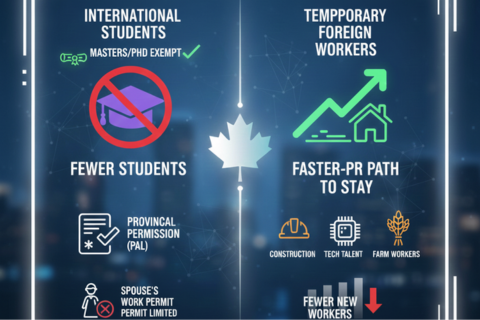
Canada's Immigration Future: Key Changes for Temporary Residents
The federal government has signaled substantial policy shifts that will significantly affect both international students and temporary foreign workers (TFWs) in Canada.
Further clarity on these policies has been provided through the 2026–2028 Immigration Levels Plan and the recent Budget 2025 proposals. Below is a summary of the most important immigration news anticipated in the coming months.
Updates Impacting Temporary Foreign Workers in Canada
Streamlined Path from Temporary to Permanent Status
- In the 2026–2028 Immigration Levels Plan, the government announced a two-year initiative (covering 2026 and 2027) aimed at expediting the transition to Permanent Residency (PR) for up to 33,000 temporary workers.
- The specific mechanism for implementing this quicker pathway has not yet been detailed.
- However, Immigration, Refugees and Citizenship Canada (IRCC) has confirmed that the initiative will prioritize current work permit holders who demonstrate strong community integration, contribute through tax payments, and are employed in specific, high-demand economic sectors.
- This approach is reminiscent of the 2021 temporary resident to permanent resident pathway, which was a time-limited program that reached its application limit immediately upon launch.
- The current focus aligns with recent trends in the Express Entry system, which has increasingly favoured candidates with Canadian work experience. The last Express Entry Year End report noted that 64% of individuals invited to apply for PR in 2024 had at least one year of qualifying Canadian work experience.
Disclaimer: To schedule a free work permit consultation, please contact the Cohen Immigration Law Firm directly.
Tightening the Temporary Foreign Worker Program (TFWP) and New Sector-Specific Pathways
Stricter Requirements for the TFWP
In September 2025, Prime Minister Mark Carney hinted at upcoming revisions to Canada’s Temporary Foreign Worker Program (TFWP).
- Focused Approach: He indicated that the TFWP must transition to a more targeted system, concentrating strictly on specific, strategic sectors and addressing proven labour demands in defined geographic regions. The methods for implementing this new, focused strategy are still to be announced.
- Reduced Admissions: The latest Immigration Levels Plan dramatically cuts the number of TFWP arrivals for 2026—reducing the target from 82,000 (in the previous year's Plan) down to 60,000. This substantial decrease strongly suggests that tighter eligibility rules will be introduced for obtaining a Labour Market Impact Assessment (LMIA), a mandatory step for securing a TFWP work permit.
- LMIA Processing Pause: This follows a previous government action that placed a freeze on processing LMIAs—essential documents for TFWP permits—in Canadian regions where the unemployment rate had reached 6% or higher.
Launch of More Sector-Specific PR Pathways
In recent years, the Canadian government has been strategically prioritizing immigration candidates who possess skills and expertise aligning with specific sectorial labour market needs. In this context, several new sector-specific Permanent Residency (PR) pathways and work permit streams are expected to be rolled out in the coming months:
- PR Pathway for H-1B Visa Holders: Announced in Budget 2025, an accelerated PR pathway is planned specifically to attract high-level talent, particularly in healthcare, research, advanced industries, and other key technology sectors.
- PR Pathway for Construction Workers: In March 2025, IRCC committed to reserving immigration spaces for up to 6,000 undocumented construction workers already in Canada.
- Agriculture and Fish Processing Stream: The 2025-2026 Departmental Plan revealed plans by IRCC to develop a dedicated stream for foreign workers in agriculture and fish processing, which will include a corresponding sector-specific work permit.
Beyond the creation of new streams, some existing PR pathways will reopen for a fresh intake period in 2026, most notably the Home Care Worker Immigration Pilots.
Advantage for TFWs: Temporary foreign workers in Canada are exceptionally well-positioned for many of these new sector-specific streams, as their prior Canadian work experience is highly valued and often provides a critical advantage in the selection process.
Upcoming Immigration Changes Impacting International Students
The federal government is introducing significant measures to control the volume of new international students arriving in Canada, aiming to make study permit applications more strategic and competitive.
1. A Slashed Study Permit Cap
- Expected Reduction: The government is expected to announce the new study permit cap sometime in January 2026. This limit governs the maximum number of study permit applications the government will accept for processing during the year.
- Likely Impact: Given that the latest Immigration Levels Plan cuts the target for new international student arrivals in half—from 305,900 down to 155,000 for 2026—it is highly probable that this processing cap will also be substantially reduced.
- Competition: This reduction could lead to more competitive study permit applications. However, Canada did not meet its international student admission targets in 2025, which suggests that the actual practical impact of the cap on potential new students may not be as drastic as the numbers suggest.
2. Exemption for Graduate Students
- No Cap, No PAL/TAL: Effective January 1, 2026, the latest Immigration Levels Plan officially exempts graduate students from the study permit cap. This means students accepted into Master’s and doctoral degree programs no longer require a Provincial or Territorial Attestation Letter (PAL/TAL), streamlining their study permit application process.
- Expedited Processing: IRCC will also move to accelerate the application processing time for doctoral degree students and their accompanying family members, aiming to issue status documents in as little as two weeks.
3. Review of PGWP Eligibility
- Program Removals Postponed: In June 2025, IRCC announced upcoming changes to the list of programs eligible for the Post-Graduation Work Permit (PGWP), directly affecting international students planning to work in Canada after graduation.
- New Deadline: This change was originally postponed in July 2025 but is expected to take effect in "early 2026." This means that 178 study programs that were slated for removal will remain eligible for a PGWP until the new announcement is made.
- Strategic Planning: International students prioritizing post-graduation work opportunities in Canada should carefully select a program that is currently PGWP-eligible when planning their studies.