


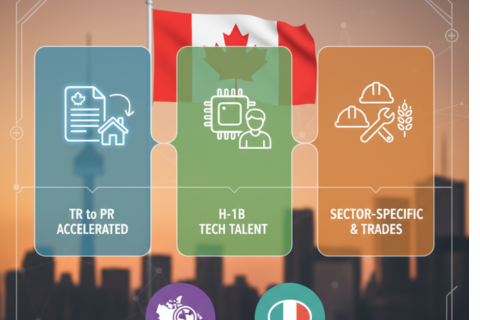
Canada is set to introduce several new pathways to permanent residence (PR) in 2026, marking a significant strategic shift toward prioritizing the transition of in-Canada temporary residents who are already contributing to the economy. Furthermore, 2026 is expected to see the reopening of intake periods for successful pilot programs that reached their application caps in 2025.
New & Accelerated Pathways
The federal government has signaled plans for the following new and accelerated PR pathways:
1. Temporary Resident to Permanent Resident (TR to PR) Accelerated Transition
In the Immigration Levels Plan 2026-2028, the government announced plans to accelerate the transition of up to 33,000 temporary work permit holders to PR over 2026 and 2027.
- Focus: This initiative will specifically target workers who have established strong roots in their communities, are paying taxes, and are actively contributing to the Canadian economy.
- Details & Eligibility: Details on the implementation and eligibility criteria for this accelerated transition are yet to be announced.
2. Accelerated Pathway for H-1B Holders
Building on a successful 2023 pilot, an accelerated PR pathway is expected for holders of US H-1B visas.
- Focus: Designed to attract highly skilled professionals in critical sectors such as technology, healthcare, and research as part of Canada's strategy to boost innovation.
- Details & Eligibility: Having a US H-1B visa will likely be a prerequisite. Specific criteria and a launch date are yet to be announced.
3. PR Pathway for Construction Workers
IRCC announced plans to admit up to 14,000 foreign national construction workers to Canada to support the housing sector, which faces persistent labour shortages.
- Target: Up to 6,000 immigration spaces will be reserved for undocumented construction workers already in Canada.
- Details & Eligibility: The government has not yet released details on when this program will begin or the specific eligibility criteria for applicants.
4. Stream for Agriculture and Fish Processing
Plans are underway to create a new sector-specific stream for foreign workers in agriculture and fish processing.
- Program Features: This stream would expand partner country agreements and include a corresponding sector-specific work permit, with a goal to launch in 2025–2026.
- Details & Eligibility: Specific details on eligibility have yet to be disclosed.
5. Replacement for the Economic Mobility Pathways Pilot (EMPP)
A new permanent PR pathway is expected to replace the existing EMPP, which helps skilled refugees and displaced people find work and settle in Canada.
- Focus: Aims to help skilled refugees and displaced people who can fill Canadian labour needs. The new program may also be used for a one-time initiative to streamline the transition to PR for about 115,000 protected persons already in the country.
- Expected Criteria: Criteria are anticipated to be similar to the EMPP, requiring proof of refugee or displaced person status and meeting additional criteria related to work experience, education, and language skills.
Re-opening of Existing Pilots
Several capped pilot programs are expected to reopen their successful application streams in 2026:
Home Care Worker Immigration Pilots
The pilots—The Home Care Worker Immigration Pilot: Child Care, and The Home Care Worker Immigration Pilot: Home Support—are expected to reopen the intake stream for applicants working in Canada in 2026.
- Core Eligibility:
- Eligible full-time job offer in Canada.
- Language proficiency: Canadian Language Benchmark (CLB 4) or higher.
- Education: Secondary school diploma or higher.
- Work experience: Six months' work experience.
Rural Community Immigration Pilot (RCIP) and Francophone Community Immigration Pilot (FCIP)
These ongoing pilots help employers in designated rural communities address labour shortages. 2026 may see the announcement of new employer designations and priority sectors/occupations in participating communities.
- Core Eligibility:
- A qualifying job offer in a priority occupation/sector chosen by the community.
- Work Experience: At least one year (1,560 hours) of related work experience in the past three years or graduation from an eligible post-secondary school in the community.
- Language: RCIP requires CLB 4–6 (depending on the job's NOC code); FCIP requires NCLC level 5 in French.
- Other: Canadian secondary school diploma (or foreign equivalent) and sufficient settlement funds.